
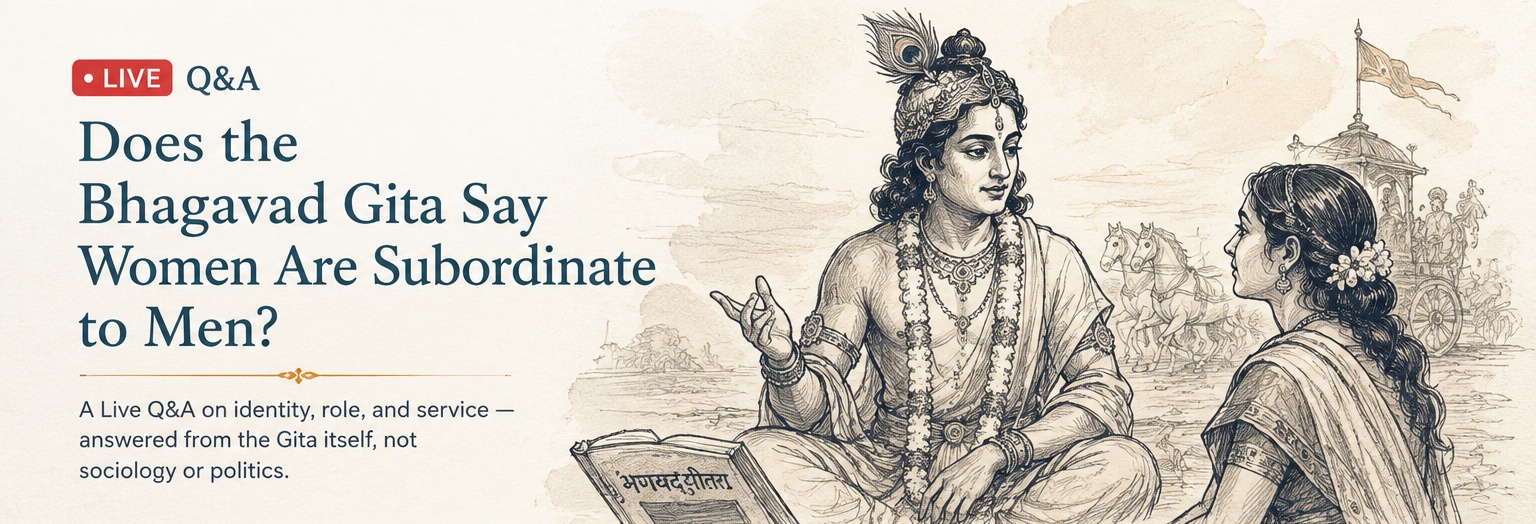
A note before we begin: This discussion stays deliberately within the Bhagavad Gita's own philosophical framework. It does not address historical practices, cultural customs, or contemporary politics carried out in the name of scripture — those are separate conversations. Here, the question is answered only from what Krishna actually teaches in the text.
Does the Bhagavad Gita teach that women are spiritually inferior to men?
No. The Gita's teaching on this is considerably deeper than a simple ranking of one gender above another. It distinguishes between four separate categories that are frequently confused in this debate: spiritual identity, bodily identity, responsibility, and service.
Most controversies around the Gita and gender arise precisely because these categories get collapsed into one another. Once we separate them clearly, the picture changes substantially.
Where does the Gita actually begin — with gender, or with something else?
It begins with the soul. Before Krishna says anything about duty, roles, or society, he establishes the single foundational teaching on which the entire Gita rests:
"For the soul there is never birth nor death... He is unborn, eternal, ever-existing, undying and primeval. He is not slain when the body is slain."
— Bhagavad Gita, Chapter 2, Verse 20
Notice what Krishna does not do. He does not begin by classifying Arjuna, or anyone else in the discussion, according to body, gender, or social position. He begins with what is actually real and permanent: the soul. Every subsequent discussion about gender in the Gita has to be read in light of this starting point, not in isolation from it.
If the soul has no gender, why do bodies differ at all?
The Gita explains that the soul takes on different bodies according to karma — the accumulated results of past action and desire. This includes male bodies, female bodies, and countless other forms of life.
"As a person puts on new garments, giving up old ones, similarly, the soul accepts new material bodies, giving up the old and useless ones."
— Bhagavad Gita, Chapter 2, Verse 22
The garment changes. The wearer does not. A male body and a female body are both, in this sense, garments — different in form, but not different in what they contain. The soul inside is the same conscious, eternal entity in either case.
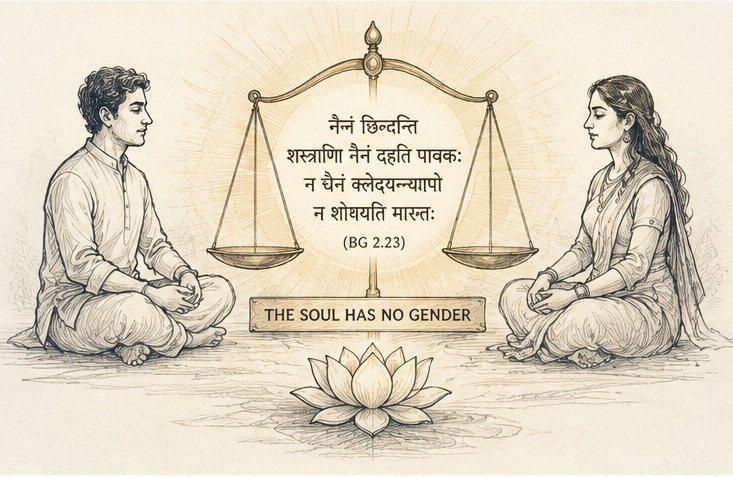
So bodily distinctions are real, but not final
This doesn't mean bodily distinctions are illusions to be dismissed — they have real, functional significance in this life. But they are temporary, in a way the soul is not. Treating a temporary distinction as though it settles a question about eternal worth is a category error.
Doesn't "different" naturally mean "unequal"?
This is one of the most common logical mistakes in this entire debate: the quiet assumption that different automatically means unequal. It doesn't, and an ordinary example makes this obvious.
Analogy: Bike and Car
A bike outperforms a car in dense city traffic — it's nimbler, cheaper to park, easier to maneuver. A car outperforms a bike on a highway — faster, safer, more comfortable over distance. Neither vehicle is superior to the other in any absolute sense. Each is different by design, and each serves a different purpose well.
Applied to gender: men and women can possess different natural strengths without either being superior or inferior. Different design does not imply different worth — it implies different function.
Are men and women's strengths actually different?
Generally speaking, yes — men and women tend to carry different natural tendencies and strengths. But this is a place to be careful, and deliberately so. Sweeping claims like "women are emotionally superior" or "men are intellectually superior" aren't useful here. They invite exactly the kind of unnecessary debate this discussion is trying to move past.
The more accurate and more useful framing is this: differences between men and women exist for the sake of cooperation, not competition. Complementarity, not rivalry. The question isn't which set of strengths ranks higher — it's how those different strengths work together.
What does Krishna consciousness actually measure — power, or something else?
Service. This is one of the most important shifts the Gita makes relative to how modern society tends to think.
Modern society commonly measures a person's value through authority — who has power over whom. Krishna consciousness measures value through service — who is serving, and how well.
Husband serves wife ⇆ wife serves husband.
The same principle repeats throughout every relationship the Gita touches: parents serve children, children serve parents, a leader serves society, a guru serves disciples. Ultimately, everyone — regardless of gender or position — serves Krishna. Krishna consciousness is therefore not built on a foundation of domination. It's built on a foundation of service, offered in both directions within every relationship.
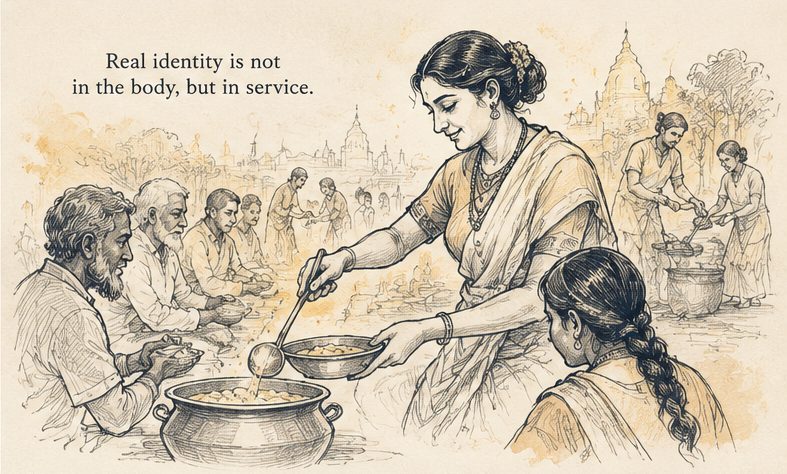
Does different responsibility mean different dignity?
No — and this may be the strongest argument in the entire discussion.
Analogy: The Cricket Team
A cricket team has a captain, a bowler, a batsman, a wicketkeeper. Each has a different responsibility. All are on one team. If everyone insisted on becoming captain, the team would collapse — not because the other roles are beneath anyone, but because a team requires different functions to work as a whole.
Scriptures may describe different responsibilities for different people. That alone does not establish greater or lesser spiritual worth. What it establishes is a functioning whole, the same way a cricket team functions because its players accept different roles rather than competing for the same one.
An important refinement: leadership is not privilege
Leadership in Vedic culture should never be presented as privilege. Leadership means greater responsibility, greater sacrifice, and greater accountability — never domination. A captain who treats the role as a privilege rather than a duty has misunderstood what leadership is for.
The Key Distinction: Role Is Not Worth
This is the hinge the entire discussion turns on. People routinely mistake role for worth. Once a role becomes equated with worth, comparison begins. Comparison creates competition. And once competition sets in, people stop asking a productive question and start asking a corrosive one.
Identity → Role → Service.
Identity is the eternal soul. Role is a temporary responsibility, assigned by circumstance and nature. Service is the eternal principle that applies equally to everyone, regardless of role. Krishna consciousness keeps these three categories distinct. Confusing them is where most of the controversy actually originates — not in the Gita's text itself, but in how readers conflate identity, role, and worth into a single measurement.
Once role and worth are separated, the question changes entirely. Instead of asking "why don't I have that position?" — a question rooted in comparison — Krishna consciousness asks: "Am I serving Krishna through the role He has entrusted to me?" That is a fundamentally different question, and it removes the comparison altogether.
Objection: If men and women are spiritually equal, why do scriptures prescribe different roles at all?
Because different responsibility does not mean different dignity. Responsibilities may differ from person to person, and from role to role. Spiritual worth does not. Return to the cricket team: the bowler's responsibility differs sharply from the wicketkeeper's, yet neither is worth less to the team because of it. The same logic applies to any prescribed role in scripture — a differentiated responsibility is not a statement about differentiated worth.
Objection: I understand the argument, but I'm still not convinced.
That reaction is worth taking seriously rather than dismissing. A likely reason for it: we instinctively compare roles, almost as a reflex. Once that comparison begins, competition follows close behind, even when we don't intend it.
Krishna consciousness deliberately redirects attention away from that comparison and toward service instead. This isn't a rhetorical trick to end the conversation — it's a genuine shift in what question is being asked. The discomfort of "I'm still not convinced" often comes from not yet having made that shift, not from a flaw in the argument itself. It's worth sitting with the question a while longer rather than resolving it too quickly in either direction.
Where This Leaves Us
The Bhagavad Gita does not ask "who is greater?" It asks "how should I serve?" That single reframing changes the entire conversation about gender within the text.
The highest identity, according to the Gita, is not male. It is not female. The highest identity is the eternal servant of Krishna — a description that applies equally, without exception, to every soul regardless of the body it currently occupies.
Spiritual equality and functional diversity are not in conflict. They coexist. Different responsibilities do not imply different dignity. And competition over identity gives way to cooperation in service, once role and worth are correctly understood as separate things.
Frequently Asked Questions
Does the Gita say the soul has a gender?
No. The Gita identifies the soul as eternal and unchanging (Chapter 2, Verse 20), distinct from the temporary body it occupies. Gender is a characteristic of the body received according to karma, not a characteristic of the soul itself.
Does complementary strengths mean women or men are inferior?
No. The discussion deliberately avoids ranking one set of tendencies above another. Different natural strengths are described as existing for cooperation, not competition — comparable to how a bike and a car each perform better in different conditions without either being the superior vehicle.
How does the Gita define leadership?
As greater responsibility, greater sacrifice, and greater accountability — not as privilege or domination. A leader's differentiated role does not elevate their spiritual worth above those they lead.
