
It's 11:40 p.m. The house is quiet except for one soft blue glow under a bedroom door. You knock, gently at first, then not so gently. A muffled “five more minutes” comes back — the same five minutes that was promised an hour ago. You're not angry about the phone anymore. You're worried about who your child is becoming inside it.
If that scene is familiar, you are far from alone. A 2024 study of teenagers aged 15 to 19 in Gujarat found smartphone addiction in 64.6% of them; a follow-up study in 2025 put the figure at over 70%. Separately, surveys have found that 85 to 89% of Indian parents say they're actively worried about their teenager's screen time. This isn't a fringe concern anymore — it's dinner-table conversation in almost every home with a teenager and a Wi-Fi connection.
I've written before about how the mind can be our best friend or our worst enemy, and about the quieter loneliness a hyperconnected life can create. This piece sits between those two — not about our own restless minds this time, but about the particular battlefield a parent faces when it's their teenager's mind at stake. And this time, I want to bring in a story from the Mahabharata as well as the Gita, because I think it says something about attention that no verse alone quite captures.

Key Takeaways
- Teen screen addiction isn't a willpower failure — it's the mind's natural pull toward stimulation, a pattern the Gita names precisely.
- The Gita's fix isn't suppression. It's abhyasa (steady practice) paired with vairagya (non-attachment) — small, repeated redirection, not one dramatic ban.
- How a parent responds matters more than what they say. Krishna teaches Arjuna through patient dialogue, not lecture — and teenagers can tell the difference instantly.
- A story from the Mahabharata — Dronacharya's wooden-bird test — shows what a trained mind looks like in a room full of distraction.
- The goal isn't a screen-free teenager. It's a teenager who has a self worth returning to when the screen goes dark.
Why Today's Teens Are Wired Differently Than You Were
Let me say this plainly first, because I think it changes how a parent walks into this whole conversation: your teenager's brain is not weaker than yours was at their age. It's being asked to resist something engineered by thousands of designers and behavioural psychologists whose entire job is to make putting the phone down feel slightly harder than picking it up. Every scroll, streak, and notification runs on the same mechanism that makes slot machines addictive — variable reward.
Layer teenage brain development on top of that. The adolescent reward system matures years before the self-control system does, which is exactly why teens are more vulnerable to this pull than adults, not less disciplined. Add academic pressure, thinning real-world friendships, and parents who are often modelling the same behaviour on their own phones, and you get a near-perfect storm.
None of this means the situation is hopeless. It means the starting point has to change — from “why won't you just stop” to “what is actually happening in your mind right now.” That second question is exactly where the Gita begins too.
What the Gita Already Told Us About This Mind
In Mastering Your Mind (Part 5), I wrote about Krishna's teaching in Bhagavad Gita 6.6 — that for one who hasn't trained the mind, the mind itself becomes the greatest enemy. I used Heath Ledger's tragic immersion in a role to show how a mind, left untrained, can pull even a brilliant person somewhere they never intended to go.
A teenager at 11:40 p.m., phone glowing, is living a smaller, more everyday version of the same struggle. They are not choosing, in any real sense, to stay up. Their mind — untrained, and up against an app designed by professionals to exploit exactly that lack of training — is doing what an untrained mind does. The moment a parent sees it this way, “my child versus their own mind” rather than “my child versus me,” the temperature of the conversation drops. You stop being the opponent. You can become the ally.
“For him who has not conquered the mind, the mind is the greatest enemy; but for him who has conquered it, the mind is the best of friends.”
— Bhagavad Gita, Chapter 6, Verse 6
There's a second verse worth bringing in here: Bhagavad Gita 2.67, where Krishna compares the senses to wind, capable of sweeping away even a well-built boat's intelligence. A phone isn't one temptation — it's dozens of small winds hitting from every direction: a message, a reel, a streak reminder. Telling a teenager to “just have more willpower” is like telling someone in a storm to row harder without ever mentioning the sail.
“As a strong wind sweeps a boat off its chartered course on the water, even one of the roaming senses on which the mind focuses can carry away a man's intelligence.”
— Bhagavad Gita, Chapter 2, Verse 67

This is exactly why I've watched blunt-force restriction backfire again and again. It deals with one gust of wind. It teaches nothing about steering the boat. The moment the phone comes back — or a friend's phone is available — the same pull returns, often stronger, now tangled up with resentment.
What Drona Taught With a Wooden Bird
If Chapter 6 tells us the mind can be trained, the Mahabharata shows us what that training actually looks like in practice — and it's one of my favourite stories to tell parents.
Before the Pandava and Kaurava princes ever picked up weapons for war, their teacher Dronacharya set up a test. He placed a wooden bird high in a tree and, one by one, called each prince forward with a bow. Before letting anyone shoot, he asked each of them the same question: “What do you see?”
Yudhishthira said he saw the tree, its branches, the bird, and his brothers standing around him. Drona sent him back without letting him shoot. Duryodhana and the others gave similarly full, honest, detailed answers — describing the whole scene in front of them — and each was turned away in turn.
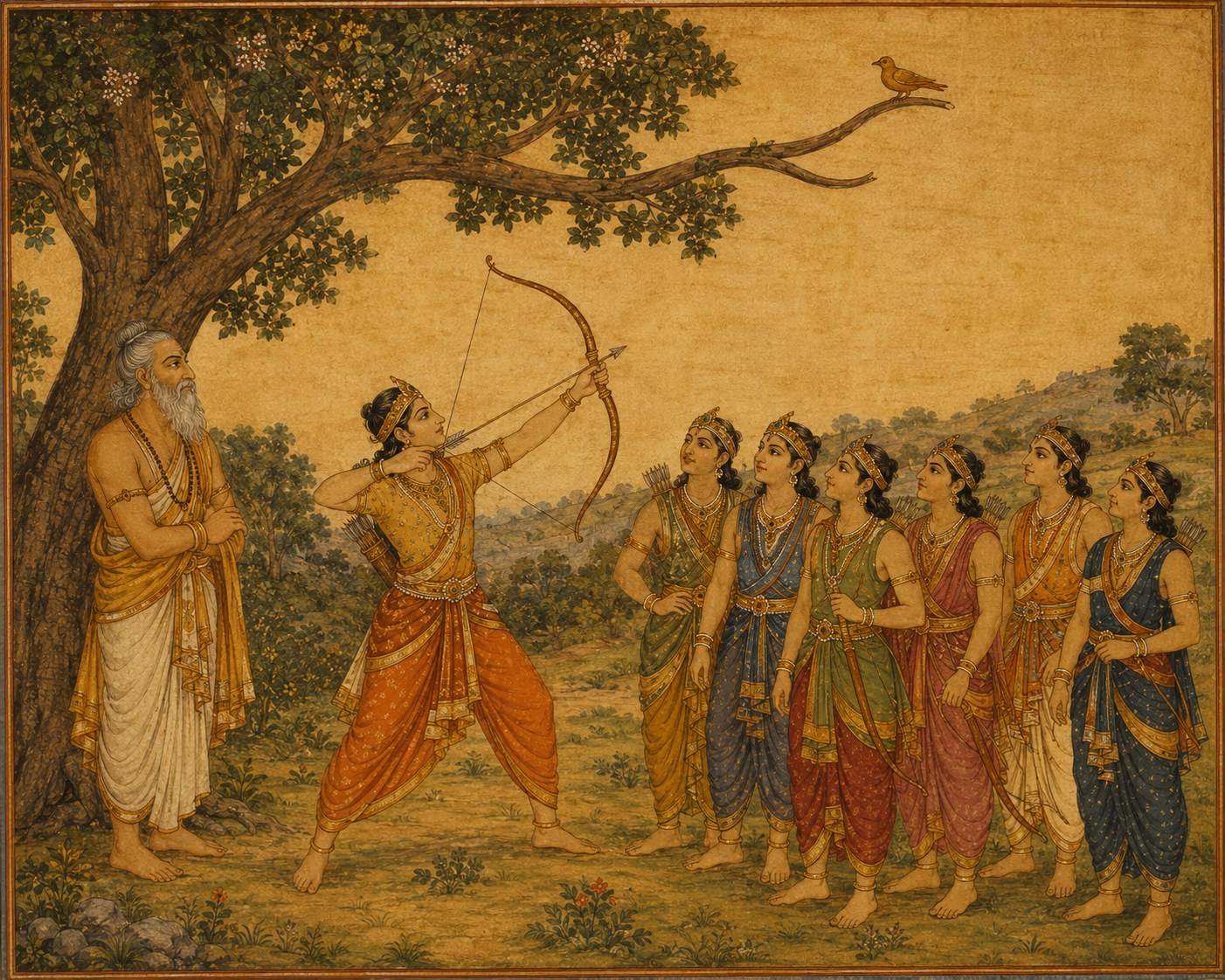
Then Arjuna stepped up. Asked what he saw, he said: “I see only the bird.” Drona pressed him — nothing else, not the tree, not the sky? “Now I see only its head,” Arjuna answered. Drona told him to shoot. The arrow found its mark instantly.
I think about this story every time a parent asks me how a teenager who “can't sit still for five minutes” without a phone is supposed to develop focus. The tree, the branches, the sky are the group chat, the reel that autoplays next, the streak that's about to break, the twenty other things a phone dangles in front of a teenager every time they pick it up. What Arjuna had, that the others didn't, wasn't better eyesight. It was a trained mind that had decided, in advance, what actually mattered in that moment — everything else was allowed to simply fall away.
That's not a talent teenagers either have or lack. It's a skill Drona built in Arjuna the same way any teacher builds it in a student: repetition, over time, with a clear standard of what “seeing only the bird” actually means in practice. Which brings us back to abhyasa.
The Real Fix: Practice Over Punishment
So what does the Gita actually recommend, if not restriction? The same discipline that built Arjuna's focus at the wooden bird didn't arrive in one lesson — it was years of daily practice under Drona. Krishna is specific about this method too, and it's more practical than most people expect. He answers this directly in 6.35: the mind is indeed restless and hard to control, “but it is subdued through practice… and by detachment.” Two words carry the whole method — abhyasa (steady, repeated practice) and vairagya (non-attachment, not aversion). Krishna never suggests the mind can be forced still in one dramatic act. It's trained the way a muscle is trained: small, consistent redirection, repeated until it becomes natural.
“Undoubtedly the mind is restless and difficult to curb, but it is subdued through practice, O son of Kunti, and by detachment.”
— Bhagavad Gita, Chapter 6, Verse 35
In a household with a teenager, this looks less like a 30-day phone ban and more like:
- Small, repeatable boundaries — phone-free dinners, a charging station outside the bedroom at night — rather than one sweeping rule that gets tested and broken within days.
- Building genuine alternatives, not empty time. Vairagya isn't deprivation; it's the pull losing its grip because something else — a sport, a craft, real friendship, a sense of purpose — is genuinely more satisfying. This connects directly to the disconnection I wrote about in Loneliness in a Digital World: the antidote to a hollow digital pull is rarely more rules, it's more real connection.
- Modelling it yourself. A teenager who watches a parent put their own phone away at dinner absorbs the lesson faster than any conversation could teach it.

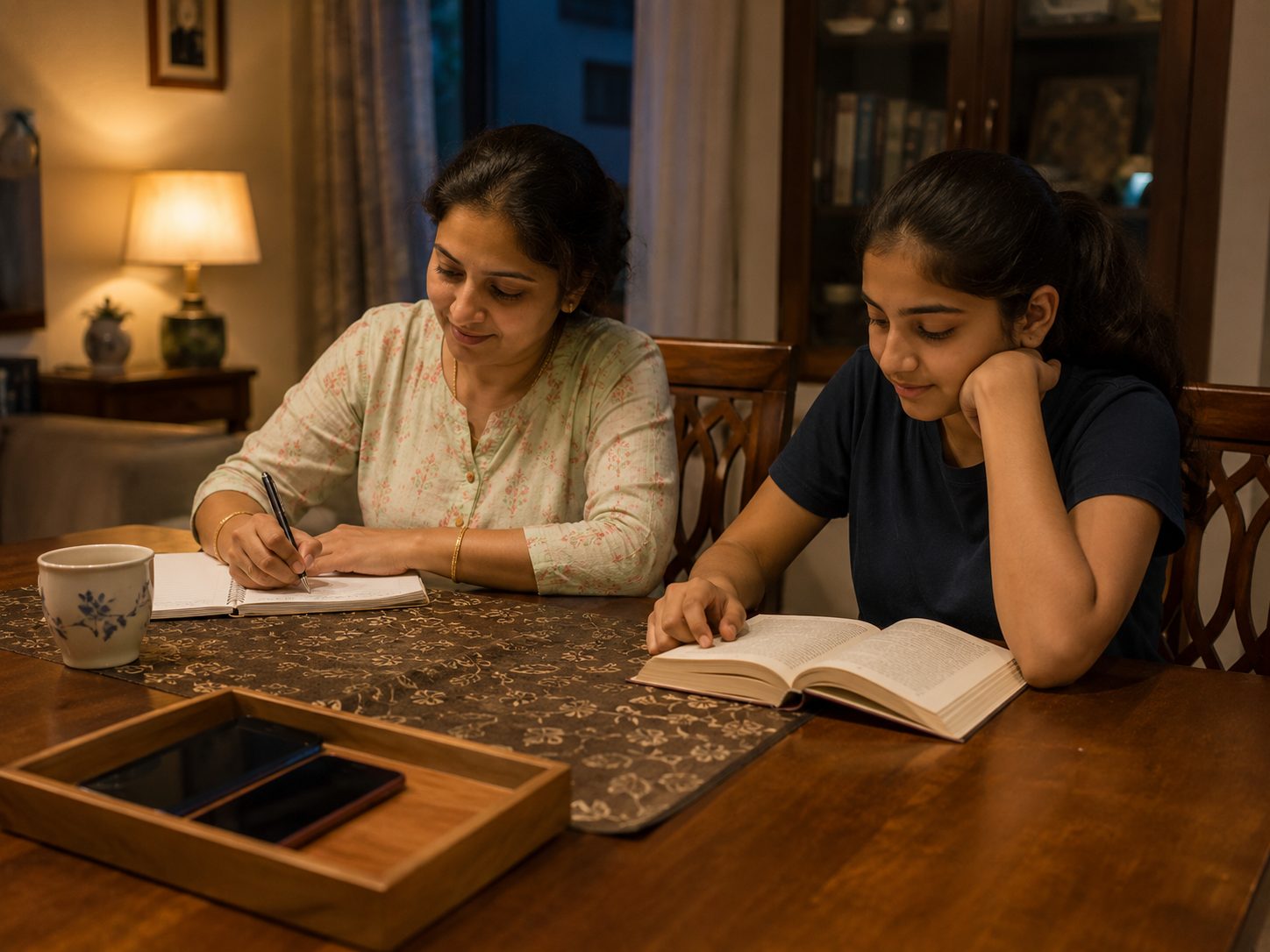
Picture what this looks like in practice: instead of confiscating the phone outright during exam season, a parent and teenager agree on a shared “focus block” — say, 6 to 8 p.m., both phones in a drawer, both doing their own work at the same table. No lecture, no enforcement drama. It won't feel like progress in week one. That's the point — abhyasa isn't a rule imposed in a single dramatic moment; it's a habit built together, slowly enough that it survives the first week it gets tested, the same way Arjuna's focus was built one practice session at a time, not by a single stern lecture from Drona.
Bringing This Home: What It Looks Like on a Tuesday Night
Krishna's method of teaching Arjuna is itself worth borrowing, and I say this to parents often. He never once tells Arjuna to simply obey. He listens to Arjuna's confusion across nearly two full chapters before teaching him anything, answers it seriously, and lets him arrive at his own resolve. That's the model for a parent-teen conversation about screens — not “because I said so,” but genuine dialogue that respects the teenager's intelligence.
Practically, this might mean opening with “I've noticed you seem more tired lately — do you feel like your phone is helping you unwind, or is it making it harder to actually rest?” instead of “you're on that phone too much.” That question invites reflection instead of defensiveness. It treats the teenager as someone capable of noticing their own patterns, which, more often than adults expect, they genuinely are.

Where This Can Go Further: Evolve Pune's Gita for Teens Program
If this is a live struggle in your home, it's worth knowing that Gita wisdom for teenagers isn't only something to read about — Evolve Pune's Gita for Teens program was built for exactly this age group, translating these same ideas — the trainable mind, identity beyond a feed of likes, purpose worth protecting — into a format that actually speaks to how teenagers think, alongside guidance for parents so the change doesn't happen in isolation at home.
We've run this for teenagers both in India and, most recently, for a group in the UK. Here's what actually happened, in their own words — not ours.
Over 60 teens took part in the UK batch, and more than 30 joined in India. Here's some of what came back in their feedback:
“It was great to see how easy and relatable Gita teachings became for teens for their day to day lives — and if the basics are set, how easy it will become to take tough decisions for them and setting boundaries for themselves.”
— Yashima, UK
“I found the course to be very interesting and actually useful for daily life use.”
— Siri, UK
“It was informative and made the children understand how the Gita truly relates to our everyday life.”
— Amisha, parent, UK
Want to hear it directly from the teens themselves? Our Indian batch recorded their own video reflections after the course — watch the full video feedback playlist here.
Join the Next Batch
We've set up a dedicated WhatsApp group for parents and teens who want details on the next Gita for Teens batch — no spam, just updates on dates and how it works.
Frequently Asked Questions
Does the Bhagavad Gita actually say anything about screens or phones?
No, obviously not directly. But it says a great deal about the mind and the senses, and why the same object can enslave one person and mean nothing to another. Krishna's teaching on the restless mind in Chapter 6, and the senses compared to wind in Chapter 2, map with striking precision onto how screens hook attention today.
Is it realistic to get a teenager to reduce phone use using spiritual teachings?
Not by quoting verses at them. It works when a parent internalizes the underlying principle — non-judgmental steadiness — and changes how they respond, rather than preaching the Gita to the teen directly. Teenagers resist sermons; they notice consistency.
How much screen time is considered a problem for a teenager in India?
There's no single universal number, but red flags include sleep loss, falling grades, withdrawal from family or in-person friendships, and distress when the phone is unavailable. It's less about total hours and more about whether the teen still has a functioning life outside the screen.
What does the story of Arjuna and the wooden bird have to do with screen addiction?
It's a picture of trained attention. Arjuna wasn't gifted with better eyesight than his brothers — he had a mind trained, through years of practice, to see only what mattered in the moment. That is exactly the skill a teenager needs to build against a phone engineered to pull attention in twenty directions at once — and, like Arjuna's skill, it's built through practice, not a single lecture.
What is Evolve Pune's Gita for Teens program?
It's a program designed specifically for teenagers, translating Gita wisdom on focus, identity, and self-worth into a format that resonates with how teens actually think — without being preachy or textbook-heavy. It includes parent guidance sessions as well.
Summary
Screen addiction in teenagers isn't a discipline problem to be punished away — it's an untrained mind being pulled by forces it doesn't yet know how to steer, exactly as the Bhagavad Gita described thousands of years before the first notification ever buzzed, and exactly what Dronacharya was training out of his students long before any of them picked up a weapon. The way forward is steady practice over sudden restriction, dialogue over lecture, and helping a teenager build a self worth returning to when the screen goes dark.
