
The Night That Changed Without Warning
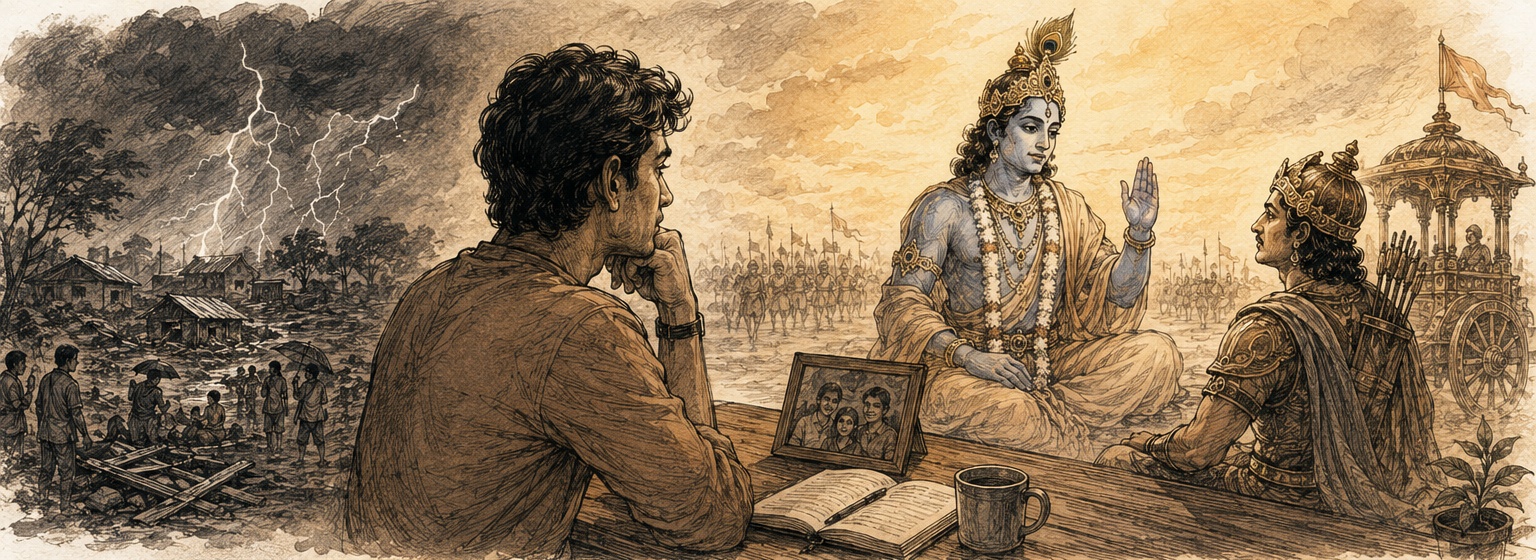
In May 2026, a storm swept through Uttar Pradesh. By morning, 89 people were gone. No warning sirens, no time to finish a conversation, no chance to say the thing that had been sitting unsaid for months or years. One ordinary night, and everything after it was different for dozens of families.
Stories like this surface in the news for a day or two, generate a wave of concern, and then quietly recede as life resumes its normal pace. But underneath the headline is a question most of us actively avoid: if a night like that happened to me, would I have any regrets about how I spent today?
What the Bhagavad Gita Actually Says About Death
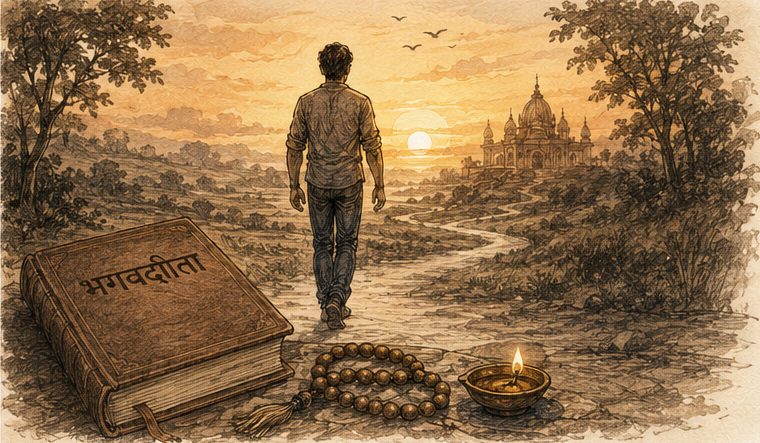
This isn't a new anxiety invented by modern news cycles. It's one of the oldest questions in human history, and the Bhagavad Gita addresses it directly. When Arjuna stands frozen on the battlefield, overwhelmed by the prospect of loss, Krishna doesn't comfort him with denial. He tells him the truth plainly.
"For one who has taken his birth, death is certain; and for one who is dead, birth is certain. Therefore, in the unavoidable discharge of your duty, you should not lament."
— Bhagavad Gita, Chapter 2, Verse 27
We tend to nod along with a verse like this as though it's obvious — of course everyone dies eventually. But intellectually agreeing with a fact and actually living in light of it are two very different things. Most of us function, day to day, as if we've quietly signed a contract guaranteeing more time.
The Myth of the Guaranteed Rewrite
"I'll fix that relationship next month." "I'll start meditating when work slows down." "I'll tell them how I feel when the moment is right." These aren't lies exactly — they're postponements, and they rest on an assumption none of us can actually verify: that things will settle down, and that we'll get another shot.
Often, they don't settle down. They simply stop — sometimes without asking permission, the way that storm did.
Why we default to postponement
Psychologically, this isn't laziness. It's a coping mechanism. Confronting mortality directly, all the time, would be paralyzing. So the mind quietly edits death out of daily planning. The Gita doesn't ask us to obsess over death — it asks us to hold the fact of it lightly but honestly, so that it informs our choices instead of being suppressed by them.
Urgency as a Gift, Not a Threat
It's worth being clear about what this teaching is not. It is not meant to scare you into anxious hypervigilance about death. Krishna's tone throughout the Gita is calm, not alarmist. The point of remembering mortality is not fear — it's clarity.
Urgency, rightly understood, is simply honesty about time. When you know a resource is limited, you use it more intentionally. Time is the most limited resource any of us has, and yet it's the one we treat as infinite.
A shift in framing
Instead of "I might die, so I should be afraid," the Gita's framing is closer to: "I will certainly die one day, so today actually matters." That single shift — from fear to clarity — changes how a person spends an evening, has a conversation, or treats someone they love.
What Srila Prabhupada Added: Prepare Now, Not Someday
Srila Prabhupada, founder-acharya of ISKCON, returned to this exact point often in his lectures, and he was characteristically blunt about it — not to frighten anyone, but because he saw the same postponement the Gita warns against playing out in ordinary people's lives.
"There is no guarantee. Even in your ordinary life you are going by the car, there may be accident… So many people are dying. He does not expect that 'I am going to office. I shall be killed.'… So there is no guarantee. Any moment we can die."
— Srila Prabhupada, lecture on Bhagavad Gita 10.34 & 2.13
He wasn't making a morbid observation for its own sake. He tied it directly back to the Gita's teaching that death is only a change of body, not an ending: "After death, we will have to accept another body — tathā dehāntara-prāptiḥ" (Bhagavad Gita 2.13). The urgency, for him, was never about fear of the unknown. It was about not wasting the specific, limited opportunity this life represents.
"Before death we must prepare ourselves, what is next body. If we are not doing that, then we are killing ourselves… Tyaktvā dehaṁ punar janma naiti mām eti kaunteya [Bhagavad Gita 4.9]."
— Srila Prabhupada, lecture, Edinburgh, 16 July 1972
That verse he quotes, Bhagavad Gita 4.9, is the same idea in Krishna's own words: one who truly understands Krishna does not take on another material body after death. The practical instruction underneath all of this is simple — use this life, now, for the thing that actually matters, rather than assuming there will always be a next one to get around to it.
Prabhupada put the choice in its starkest form once, in a way that cuts through most of our usual excuses:
"You have to give up this body. Why don't you give it up for the highest cause?… Everyone has to offer his body at the end. But the man who sacrifices this body for the purpose of self-realization, he's the most intelligent man."
— Srila Prabhupada, lecture, New York, 5 April 1966
Three Questions to Ask Yourself Tonight
This teaching only means something if it's applied, not just understood. Three simple questions, asked honestly tonight, can turn this reflection into something real:

1. Is there someone you need to call today?
Not eventually. Today. A short message, even an imperfect one, closes a loop that might otherwise stay open indefinitely.
2. What apology have you been rehearsing only in your head?
Rehearsal isn't the same as delivery. If you've composed the words a dozen times in your mind, the only thing left is to actually say them out loud.
3. What have you been "waiting for the right time" to start?
A practice, a habit, a difficult conversation, a course correction. The right time is rarely announced in advance. Often, it's simply now.
Frequently Asked Questions
Why does the Bhagavad Gita say death is certain?
In Chapter 2, Verse 27, Krishna tells Arjuna that death is certain for anyone who is born, just as birth is certain for anyone who has died. This is presented as a natural law, not a punishment, and is meant to help Arjuna act with clarity instead of being paralyzed by grief and fear.
Is the Gita's teaching on death meant to be frightening?
No. The intent is to bring clarity and urgency to how we live, not fear. Krishna's guidance throughout this section of the Gita is calm and instructive, encouraging Arjuna to act rightly rather than be overwhelmed by anxiety about loss.
How can I apply this teaching practically in daily life?
Start small: reach out to someone you've been avoiding, say an apology you've only rehearsed silently, or begin a practice you've been postponing. The teaching is meant to close the gap between what you intend to do "someday" and what you actually do today.
What did Srila Prabhupada teach about the certainty of death?
Prabhupada taught that death can come at any moment, without warning, and that this uncertainty (drawn from Bhagavad Gita 2.13 and 10.34) should prompt serious spiritual preparation now rather than later — not out of fear, but so that one's remaining time is used for what actually matters (Bhagavad Gita 4.9).
