
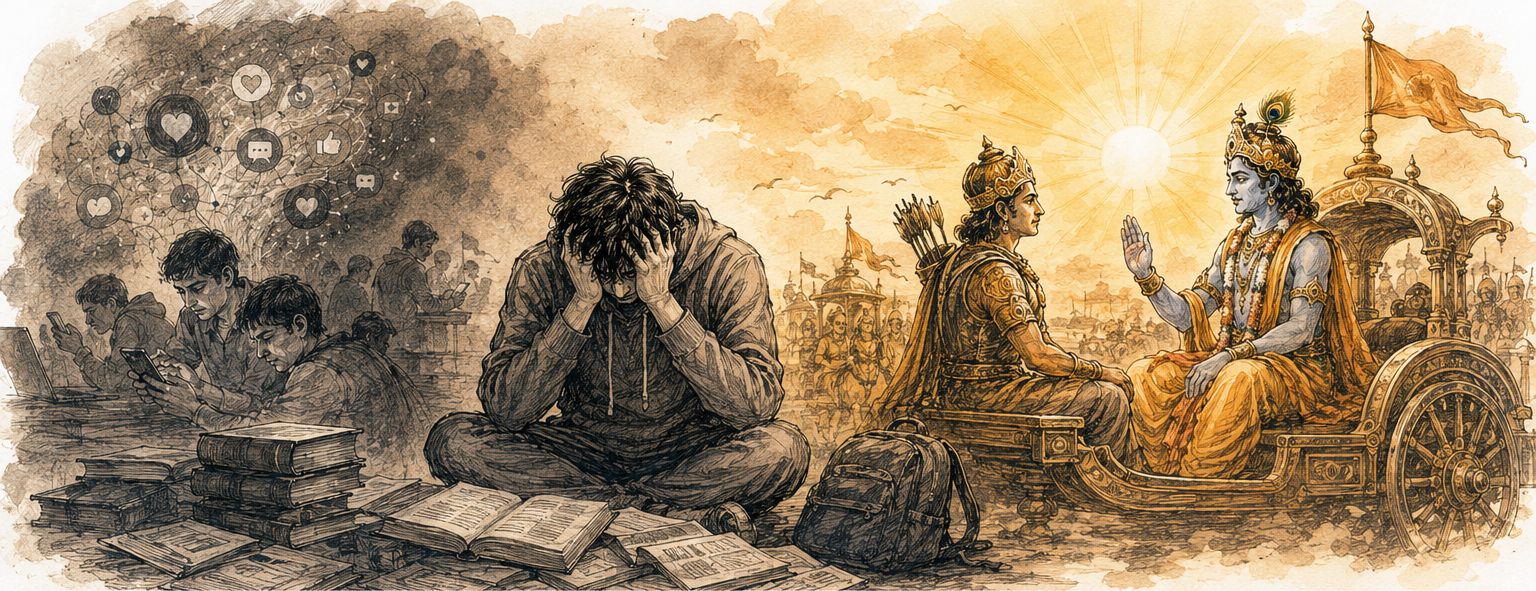
The Bhagavad Gita Did Not Begin as a Philosophy Lecture — It Began With a Breakdown
It's easy to forget, after centuries of the Gita being studied as scripture, that it opens in the middle of an acute psychological crisis. Arjuna, a seasoned warrior who had faced battle his entire life, stands on the field at Kurukshetra and simply comes apart.
"My limbs quiver, my mouth is drying up, my body is shaking and my hair is standing on end... My bow, Gandiva, is slipping from my hand, and my skin is burning."
— Bhagavad Gita, Chapter 1, Verses 29–30
He sits down in his chariot, weapons dropped, "overwhelmed with compassion and lamenting, his mind bewildered, his eyes full of tears" (BG 1.28, 2.1). For a Kshatriya of his era — trained since childhood to face death without flinching — this was extraordinary. This was not mild stress. This was despondency severe enough to make a trained warrior refuse to fight.
This matters, because it means the entire Bhagavad Gita — every verse of it — is Krishna's real-time response to someone in genuine crisis. It was never a detached philosophy seminar. It was an intervention.
What Krishna Actually Did About It
Krishna doesn't dismiss what Arjuna is feeling, and he doesn't merely sympathize with it either. He does something more demanding: he addresses the actual root of the disturbance — a mind that has lost its fixed point — rather than only soothing its symptoms.
This is the pattern worth noticing. Krishna's method across the Gita is to steady a disturbed mind by giving it something unshakeable to stand on: right knowledge of the self, and right engagement in duty. Comfort alone wasn't the cure. A different relationship with one's own mind was.
What Srila Prabhupada Actually Taught About a Disturbed Mind
Srila Prabhupada, founder-acharya of ISKCON, addressed the question of mental disturbance directly and repeatedly in his letters, drawing the same conclusion the Gita itself does — that the mind can be steadied, not by suppressing distress, but by fixing it on something higher.
"What is the explanation of split-personality? Actually, there are not two personalities, there is only change of mind. Therefore, the mind has to be fixed up in Krishna, then there is no more extreme change of the mind from one personality to another... If such a person is a devotee, the best remedy is to sit down very tightly and chant Hare Krishna very loudly and hear for a long time until he feels himself one-minded and fixed on Krishna's lotus feet."
— Srila Prabhupada, Letter to Harsāraṇī d.d., Mayapur, 28 February 1972
He returned to this theme often, always with the same underlying instruction: don't be defeated by a difficult mental state, and don't face it alone.
"Krishna does not like to see His sincere devotee suffer or become frustrated or depressed. He will not stand idly by in any such case, so do not fear on that account."
— Srila Prabhupada, Letter, Bombay, 19 December 1972
"Do not be depressed. All along my godbrothers gave me only depression, repression, compression — but I continued strong in my duty. So never mind there is some discouragement, continue with your work in full enthusiastic Krishna consciousness attitude of service."
— Srila Prabhupada, Letter to Gurudasa, Los Angeles, 29 August 1972
Notice what he doesn't say here: he doesn't say the discouragement wasn't real, and he doesn't pretend it should simply be ignored. He acknowledges it plainly, then points past it, toward purposeful engagement. This is entirely consistent with a body of care that also takes the physical body seriously:
"If you follow our regulation of diet, sufficient sleeping, and keep to the prescribed rules of cleanliness... you will be able to keep yourself in proper health. Of course, disease will always be there at some time while there is this material body, but this we must tolerate and not be very agitated by. Actually, the Vaishnava who knows that he is not this body does not therefore neglect his body, but he takes very nice care so he may utilize his body in service."
— Srila Prabhupada, Letter to Balabhadra dasa, Columbus, Ohio, 12 May 1969

Taken together, this is a coherent teaching, not a slogan: the self is more than a disturbed state of mind, that disturbance is real and worth taking seriously, and the way through it is a fixed, purposeful engagement of the mind — not merely talking about the problem, and not facing it in isolation.
Why This Also Explains Addiction, Not Just Anxiety
Prabhupada connected this same principle to addiction — another response to inner distress that awareness campaigns alone rarely resolve. His argument was that intoxication offers a counterfeit escape rather than a real one.
"You drink something, become intoxicated. But as soon as that intoxication is over, all your intoxicated dreams are over, finished."
— Srila Prabhupada, commentary on Srimad-Bhagavatam
His proposed remedy was not merely willpower or restriction, but replacement — what is sometimes called a "higher taste": "When we awaken our Krishna consciousness, then all of those frustrations disappear, and so all such problems like drug addiction become unnecessary" (Room Conversation, Perth, 16 May 1975). The logic mirrors his teaching on depression exactly: don't just remove the coping mechanism, give the mind something more real to hold onto.
Why Awareness Feels Like Action — And Isn't
Sharing a post, reacting to a story, or writing "it's okay to not be okay" in a caption all feel like meaningful gestures. They cost almost nothing, and they generate a small sense of having contributed something. But awareness and action are not the same thing, and treating them as interchangeable creates a quiet, comfortable illusion of progress.
This isn't only an individual failing. Systems fall into the same trap. In May 2026, reports confirmed that Tele MANAS — India's national mental health helpline — had its funding reduced from ₹80 crore to ₹50 crore, with mental health continuing to receive roughly 1% of the country's total health budget. That fact matters, but it's a symptom of the same deeper gap this article is really about: institutions, like individuals, can mistake talking about mental health for actually building the capacity to address it. Fixing a helpline's budget, on its own, was never going to be sufficient — because the deepest layer of this crisis isn't infrastructure. It's an unfixed mind with nowhere real to stand.
The comfortable trap
The danger isn't that awareness is useless — it's genuinely the first step. The danger is stopping there and mistaking the first step for the whole journey, whether that's a person sharing a post, or a policymaker restoring a budget line, without addressing what actually steadies a disturbed mind.
The Gita's Teaching: Karma Over Words
This distinction between talking about something and actually doing something is one of the Bhagavad Gita's central themes. Krishna repeatedly steers Arjuna away from passive reflection and toward committed, right action.
"You have a right to perform your prescribed duties, but you are not entitled to the fruits of your actions... Perform your duty equipoised, abandoning all attachment to success or failure."
— Bhagavad Gita, Chapter 2, Verses 47–48
The emphasis throughout the Gita is on karma — action rightly performed — not on sentiment, discussion, or even good intentions held privately. Talking about compassion is not the same as practicing it. Discussing dharma is not the same as living it.
What this means for mental health specifically
Applied to mental health, the teaching is direct: noticing that a friend seems distant, and privately feeling concerned, is not the same as reaching out to them. The internal recognition of a problem has to translate into an external act — and, per Prabhupada's own emphasis above, into a mind that is actually engaged in something purposeful, not just informed about the problem.
What Real Action Actually Looks Like
The shift from awareness to action doesn't require grand gestures. It usually looks small, specific, and slightly uncomfortable — which is often exactly why it gets skipped in favor of an easier, more public show of concern.

Three small actions that outweigh a hundred posts
Message the one friend who's been unusually quiet, rather than sharing another general awareness post. Ask a direct, specific question — "how are you actually doing" — instead of a passing "you good?" that invites a reflexive "yeah, fine." And begin, or return to, a daily practice that fixes the mind on something higher than its own disturbance — whether that's chanting, structured study of the Gita, or simply consistent, purposeful service to others.
None of this requires perfect timing or expertise. It requires noticing the gap between what you've felt moved by online and who you've actually reached out to offline — and closing it, even imperfectly.
Frequently Asked Questions
What does the Bhagavad Gita say about action versus words?
The Gita repeatedly emphasizes karma yoga — the path of selfless action — over mere discussion or intention. In Chapter 2, Krishna tells Arjuna to perform his duty without attachment to outcome, prioritizing right action over passive reflection or talk.
Did the Bhagavad Gita actually begin with a mental health crisis?
In a real sense, yes. Chapter 1 describes Arjuna trembling, his mouth drying up, his bow slipping from his hand, and his eyes full of tears (BG 1.29–30, 2.1) — a description of acute psychological distress in a seasoned warrior. The rest of the Gita is Krishna's direct response to that crisis.
What did Srila Prabhupada teach about depression and a disturbed mind?
Prabhupada taught that a disturbed or "split" mind is steadied by fixing it firmly on Krishna through practices like chanting, and repeatedly encouraged devotees not to be defeated by depression or discouragement, framing continued purposeful engagement — not suppression of the feeling — as the way through it.
Is sharing mental health awareness content actually harmful?
Not harmful in itself — it can genuinely help normalize conversations about mental health. The concern is when awareness-sharing becomes a substitute for direct action, like checking in on someone specific, rather than a starting point that leads to it.
