
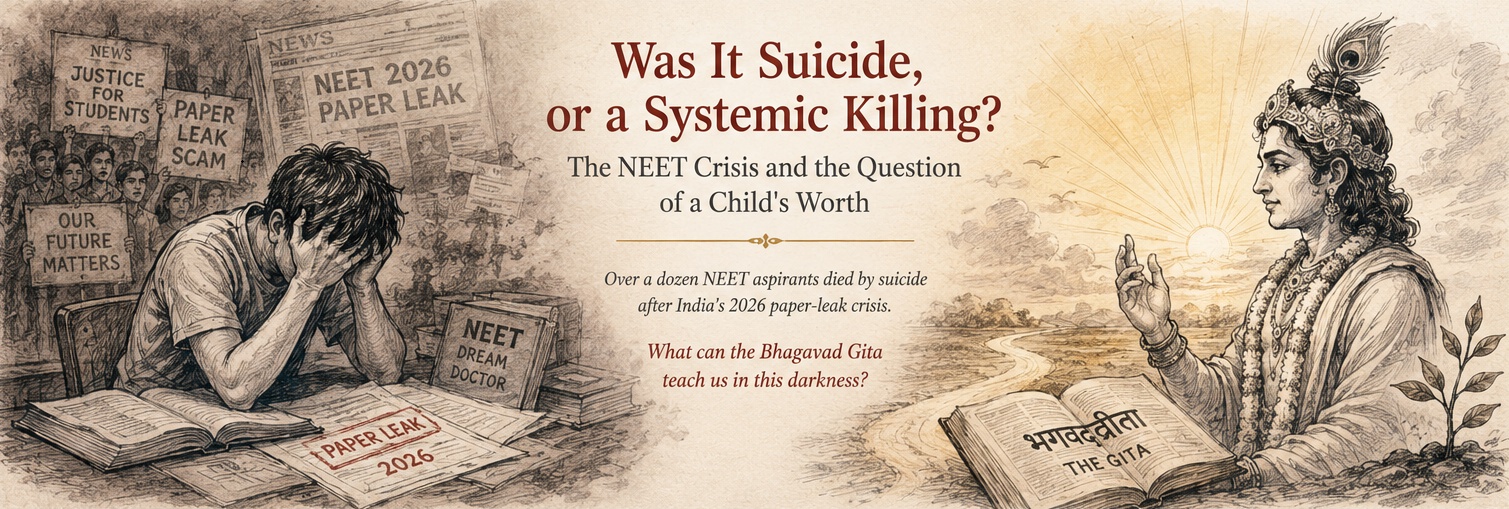
A note on this article: This piece discusses suicide in the context of a real, ongoing national crisis. It references publicly reported cases with attribution, without sensationalizing details or naming private individuals beyond what has already been widely and respectfully reported. Our aim here is to sit with the real weight of what happened and offer something sturdier than sympathy — a way of understanding worth and failure that actually holds up under pressure. A support resource is included near the end, for whenever you need it.
What Actually Happened With NEET 2026
On May 12, 2026, India's National Testing Agency cancelled the NEET-UG medical entrance exam after a large-scale paper leak was discovered. Over 2.3 million students — many from families who had sold land or taken loans to fund years of coaching — had already sat for the exam. Their results were voided overnight. A re-test was scheduled for June 21, six weeks later.
For six weeks, millions of students who believed their future was decided were told, in effect, to wait and try again. For most, that was simply exhausting. For some, it became unbearable.
The Human Toll Behind the Statistics
In the roughly 46 days between the cancellation and the re-test, at least 13 NEET aspirants died by suicide, according to compiled police records and media reporting. One young woman in Hyderabad, the night before her re-test, wrote in her note that she "lacked the courage to prepare again." Her family, like others, has said plainly: no one is responsible for this except the system that failed them.
These are not isolated statistics. NCRB data shows 14,488 student suicides in India in 2024 alone — 8.5% of all suicides in the country that year — with exam pressure and parental expectation cited repeatedly as contributing factors. This is a recurring, structural pattern, not a series of unconnected personal tragedies.
- 13+ reported NEET aspirant suicides in the six weeks after the 2026 paper leak.
- 14,488 student suicides recorded across India in 2024 alone (NCRB).
Dharma in Institutions — Who Bears the Karma of a Broken System
It would be easy, and wrong, to frame this only as a story about young people who couldn't cope. The Bhagavad Gita is unusually direct about where responsibility actually sits when a system fails the people who trusted it.
"Whenever there is a decline in righteousness and an increase in unrighteousness, O Arjuna, at that time I manifest Myself on earth."
— Bhagavad Gita, Chapter 4, Verse 7
This verse is usually read as a promise of divine intervention. Read alongside the NEET crisis, it carries a second, more uncomfortable implication: when those entrusted with dharma — administering an exam honestly, protecting the trust of millions of families — fail in that duty, the burden of that failure does not disappear. It falls on the people who had no power to prevent it. That is not fate. That is institutional accountability being quietly transferred onto the shoulders of teenagers.
Naming this clearly matters, because the families affected are not wrong to be angry. Their anger is not disrespect — it's a form of grief that has correctly identified where the failure actually occurred.
What the Gita Actually Says About Failure and Worth
The Gita's most famous teaching on action was spoken to a warrior on the edge of exactly this kind of collapse — Arjuna, paralyzed on a battlefield, convinced that everything meaningful was about to be lost.
"You have a right to perform your prescribed duty, but you are not entitled to the fruits of your actions. Never consider yourself to be the cause of the results of your activities, nor be attached to inaction."
— Bhagavad Gita, Chapter 2, Verse 47
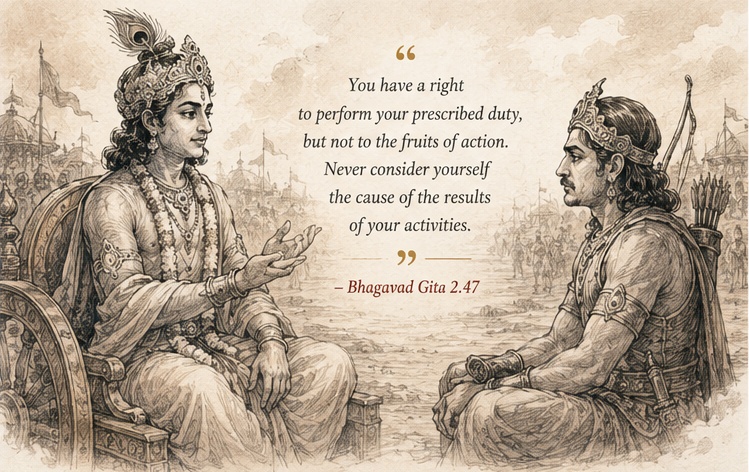
This verse is often reduced to a corporate slogan about detachment. In the context of a young person's life and a single exam score, its actual meaning is far more urgent: your effort belongs to you, and your worth is not identical to its outcome. A canceled exam, a leaked paper, a disappointing score — none of these are a verdict on who you are. They are events. Painful, unjust events, in this case. But events, not verdicts.
Why this isn't just a platitude
This teaching only becomes real when it's said before the crisis, not just after it — which is exactly why this conversation needs to happen with students and parents now, not only in the aftermath of tragedy.
You Are Not Your Rank — What the Gita Says About Who You Actually Are
Nishkama karma — acting without clinging to results — is only half of what the Gita offers here. It explains what to do with a painful result. But the deeper teaching explains something even more foundational: what you actually are, underneath any result at all.
"For the soul there is neither birth nor death at any time. It has not come into being, does not come into being, and will not come into being. It is unborn, eternal, ever-existing and primeval. It is not slain when the body is slain."
— Bhagavad Gita, Chapter 2, Verse 20
Krishna is not speaking in metaphor here. He is telling Arjuna something precise: what you are is not the body, not the mind, and certainly not a rank or a percentile. You are atma — an eternal spiritual being, temporarily wearing a body and a name and, right now, a NEET roll number. A scorecard can measure preparation on a given day. It has no authority whatsoever to measure your worth as a soul, because your worth was never dependent on it in the first place. This is not a comforting slogan invented after the fact — it is the Gita's actual metaphysics of who a person is.
"O son of Kunti, the nonpermanent appearance of happiness and distress, and their disappearance in due course, are like the appearance and disappearance of winter and summer seasons. They arise from sense perception, and one must learn to tolerate them without being disturbed."
— Bhagavad Gita, Chapter 2, Verse 14
This exam, this leak, this six-week wait — as unjust and painful as it was — is a season. Seasons pass through you; they were never meant to define you. A young person who has been taught only "study hard and you'll succeed" has no framework for when the system itself fails them unfairly. A young person who also understands this teaching has something sturdier to stand on when it does.
If You Are a Student Reading This Right Now
If an exam, a leak, a delay, or a disappointing result has made you feel like your future has ended — it hasn't, even though it may genuinely feel that way today. Your effort was real and it counted, regardless of what a scorecard says. What you are experiencing is a season, not your whole story, even when it doesn't feel that way at 2 a.m. You are not your rank. You were never your rank.
If what you're feeling has gone beyond sadness into wanting to disappear, please don't sit with that alone — tell a parent, a teacher, a friend, or use the support resource near the end of this article. Reaching out is not weakness. Even Arjuna, paralyzed on the battlefield, turned to Krishna and said plainly, "I do not know what is best for me... tell me which is decidedly good for me" (Bhagavad Gita 2.7). Asking for help is exactly what the Gita's own hero did.
If You Are a Parent Reading This Right Now
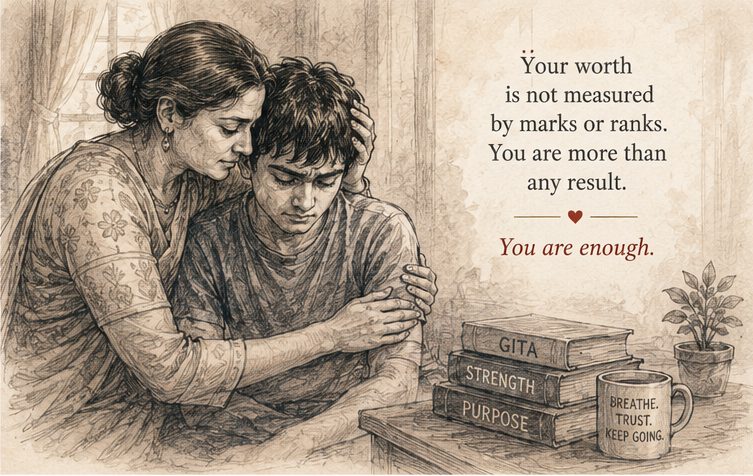
One of the most protective things a parent can say to a child before or after a result is simple and specific: "Whatever the result is, you are not going anywhere in my eyes." Not a long speech. Not a lecture about resilience. Just that single, unambiguous sentence, said before the anxiety peaks — not only after a crisis has already begun.
A practical note
Watch for withdrawal, sudden calm after a period of visible distress, giving away belongings, or talk of being a burden. These are signs worth taking seriously enough to sit down with your child directly — not to fix the exam system, which is beyond either of you, but to make sure they know their place in your family was never on the line.
If You Need Support Right Now
If you are a student, parent, or friend and this has moved past a difficult conversation into something more urgent, please use this: Tele MANAS, India's national mental health helpline, is available 24/7 at 14416, free of charge, in multiple Indian languages. It exists for exactly this moment. Calling is not an admission of weakness — it is, in the Gita's own terms, simply doing the intelligent, dutiful next thing when you are not sure what to do next.
Frequently Asked Questions
What happened with the NEET 2026 paper leak?
India's NEET-UG 2026 medical entrance exam, held May 3, was cancelled on May 12 after a large-scale paper leak was discovered. Over 2.3 million students had already appeared for the exam. A re-test was held on June 21, 2026.
How many students died by suicide after the NEET 2026 leak?
According to compiled police records and media reporting, at least 13 NEET aspirants died by suicide in the approximately 46 days between the exam's cancellation and the re-test.
What does the Bhagavad Gita say about coping with exam failure?
Two teachings apply directly. Chapter 2, Verse 47 teaches that one has the right to perform one's duty, but not to the results of that action — effort and worth are not the same as outcome. Chapter 2, Verse 20 goes further, teaching that the self is an eternal soul, not the body, mind or any external marker of success — so a result, however painful, can never actually diminish who you are.
Where can someone in India get help for exam-related suicidal thoughts?
See the "If You Need Support Right Now" section above — it has the national helpline and how to reach it.
